
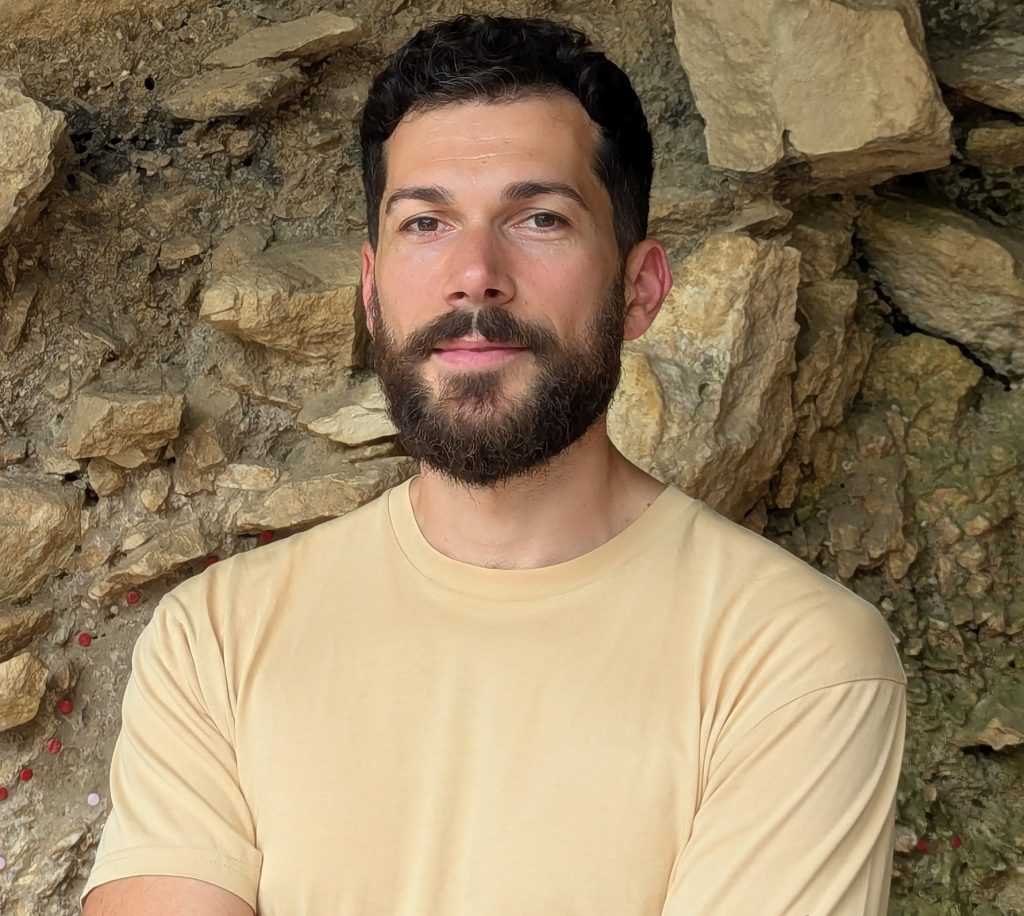
Dr. Armando Falcucci
Lecturer in Palaeolithic Archaeology
Centre for the Archaeology of Human Origins, University of Southampton
About
Armando is a Lecturer in Palaeolithic Archaeology at the University of Southampton and a member of the Centre for the Archaeology of Human Origins (CAHO). His research focuses on the biocultural dynamics of early Homo sapiens, with a particular emphasis on Mediterranean Europe, the Levant, and southern Africa. Armando specialises in the analysis of stone tools (lithics), which are the most abundant remains of human activity in deep time. Besides using traditional approaches, he is developing cutting-edge digital and computational methods for advancing lithic analysis.
Armando welcomes enquiries from prospective PhD students interested in the range of the themes listed in his Research tab, and he is happy to mentor early-career researchers preparing applications for fellowship schemes such as the Marie Skłodowska-Curie Actions.
Research interests
My research investigates the interplay between technological development, mobility, and human–climate interactions during the Late Pleistocene. I strive to combine a range of traditional, computational, and digital methods in lithic analysis to assess the role of human dispersals, cultural transmission processes, and abrupt environmental shifts in early Homo sapiens behavioural variability. Currently, my research is divided into two major geographical settings: southern Africa and the northern and eastern Mediterranean Basin.
I am working on southern African sites, with a particular focus on Boomplaas Cave (Cango Valley, South Africa), to assess the extent to which interconnectivity among hunter-gatherer groups was influenced by the marked climatic fluctuations of MIS 3. This work was initiated thanks to a Marie Skłodowska-Curie Global Fellowship, under the RStone project.
My Mediterranean research focuses on the earliest stages of the Upper Palaeolithic, a period that sees major changes in human lifeways, possibly the result of several dispersal events of Homo sapiens groups and their interaction (and interbreeding) with Neanderthal populations. I am currently working on the reference sequence of Ksâr ‘Akil in Lebanon and on several key Aurignacian sites in Italy. Here, I am directing the excavations at the site of Grotta del Fossellone on the Circeo promontory, central Italy.
Finally, I use experimental archaeology and 3D scanning to better understand the formation of lithic assemblages and thus better contextualise the archaeological findings. The creation of open-access digital repositories is an important step for advancing the field and enhancing the use of Open Science in archaeology. By applying Deep Learning to these new digital archives, I am developing new automated methods to explore the evolution of stone tool technologies.